

The Quiet Season for Close Looking
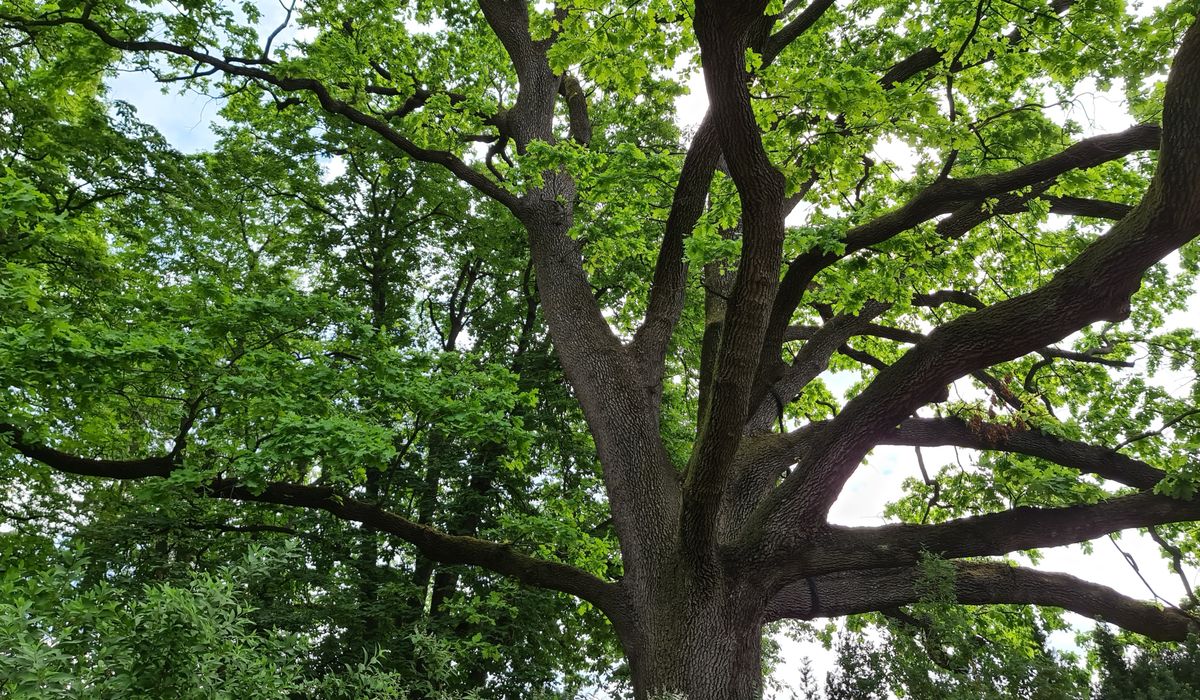
Once the leaves have gone, the British woodland stops hiding things from you. Hazel catkins might be the first thing people notice in January, but the real reward of a winter walk is learning to read the oaks — trees you have probably walked past a hundred times without ever truly seeing. With nothing but bark, buds and branches on show, the two native oaks finally reveal the differences that summer foliage blurs together.
Oak is the backbone of our countryside. A single mature oak can support hundreds of species of insects, fungi, lichens and birds, and many of our oldest trees have stood in the same field for six or seven hundred years. Learning to tell one oak from another is a small skill, but it changes how you walk through a wood.
Know Your Two Natives
Britain has two genuinely native oaks, plus the hybrids they make where they overlap.
- English oak (pedunculate oak) — the classic lowland tree of heavy clay and old parkland. Its acorns sit on long stalks, and its leaves have almost no stalk at all.
- Sessile oak — the upland tree, often called the Welsh oak. Its acorns sit directly on the twig, its leaves have a proper stalk, and it prefers thinner, more acidic soils in Wales, the Pennines, the Lake District and Scotland.
Where the two grow together they cross freely, producing trees that sit awkwardly between them. Don't worry about naming every tree with certainty — get confident on the obvious ones first.
Bark: Reading the Elephant's Hide
Oak bark is grey-brown and deeply furrowed on older trees, ridged into rough vertical plates that feel like cracked leather. Look at the trunk in raking low sunlight and the texture leaps out. A few pointers:
- English oak tends to develop a heavier, more rugged bark with deep, blocky fissures, and it is more likely to carry moss on the shaded north side of the trunk.
- Sessile oak bark is often greyer, smoother for longer on young trees, and breaks into shallower, more flaky vertical ridges rather than deep channels.
Be wary of leaning too hard on bark alone. An ancient English oak and an ancient sessile oak can look remarkably similar, and both are frequently clothed in algae, lichen and polypody fern that soften the surface. Treat bark as your opening clue, not your verdict.
Buds: The Most Reliable Winter Clue
If you want a winter identification you can trust, get close to a twig. Oak buds are arranged alternately along the stem and are gathered into a distinctive cluster at the very tip — several buds bunched together like a small clenched hand.
- English oak buds are bluntly rounded, pale reddish-brown, and crowded at the twig end. The terminal cluster is usually tight and prominent.
- Sessile oak buds are noticeably more pointed and tapered, slightly larger, and often held a little away from the stem on short stalks rather than pressed against it.
Oak buds are also covered in many overlapping scales, which gives them a pleasingly textured, almost knitted look. Once you have seen a few, you will spot oak twigs in a hedge from several paces away.
Twigs, Branching and Silhouette
Stand back and the shape of the tree tells its own story. English oak typically forms a broad, heavy, spreading crown with thick, sinuous limbs that twist and turn. Sessile oak, especially in a woodland setting, tends to be taller and more upright, with a longer clean trunk before the first major branches.
Look, too, for the small details on the twig itself. Where last year's leaf was attached you will find a leaf scar, and inside it a pattern of tiny dots — the bundle scars where sap vessels once passed through. Oak twigs also carry that characteristic knobbly, slightly zig-zag quality, with the buds sitting above each scar.
On veteran trees, watch for epicormic growth: tufts of young shoots sprouting directly from the trunk, often around old wounds or where limbs have broken away. It is a sign of a tree quietly regenerating itself, and one of the most heartening things to find in a winter wood.
Ground Clues and Standing History
Winter gives you the forest floor as well as the canopy. Sweep aside a few leaves and you may find:
- Acorns and their cups — long-stalked cups point to English oak, cups sitting tight against the twig to sessile oak.
- Shed leaves — hold one up. English oak leaves have a barely-there stalk and small lobes at the base; sessile oak leaves carry a clear stalk of a centimetre or more.
- Galls — the round, woody marble galls and spangle galls clinging to twigs and leaves are oak specialists and a wonderful reminder of how much life a single tree carries.
Woodland heritage lives in these trees. Many English oaks were once pollarded — cut above head height to produce timber and fodder — and the swollen, fist-like crowns of old pollards are unmistakable in winter. Others mark old boundaries, drove roads and parkland avenues. Learning to identify an oak is really learning to read the landscape, and there is no better season for it than this one.



John Doe
14 January, 2022Having no content in post should have adverse..
Chauffina Carr
10 April, 2022We use these tests all time! Killer stuff!
Jim Séchen
16 July, 2022Thanks for all the comments, everyone!